What's in Your Candy?
Nine of the world's favourite gummies and sugar candies, broken down by ingredient. Spoiler: it's mostly sugar, glucose syrup and a rainbow of dyes.
Swipe the table sideways to see every column →
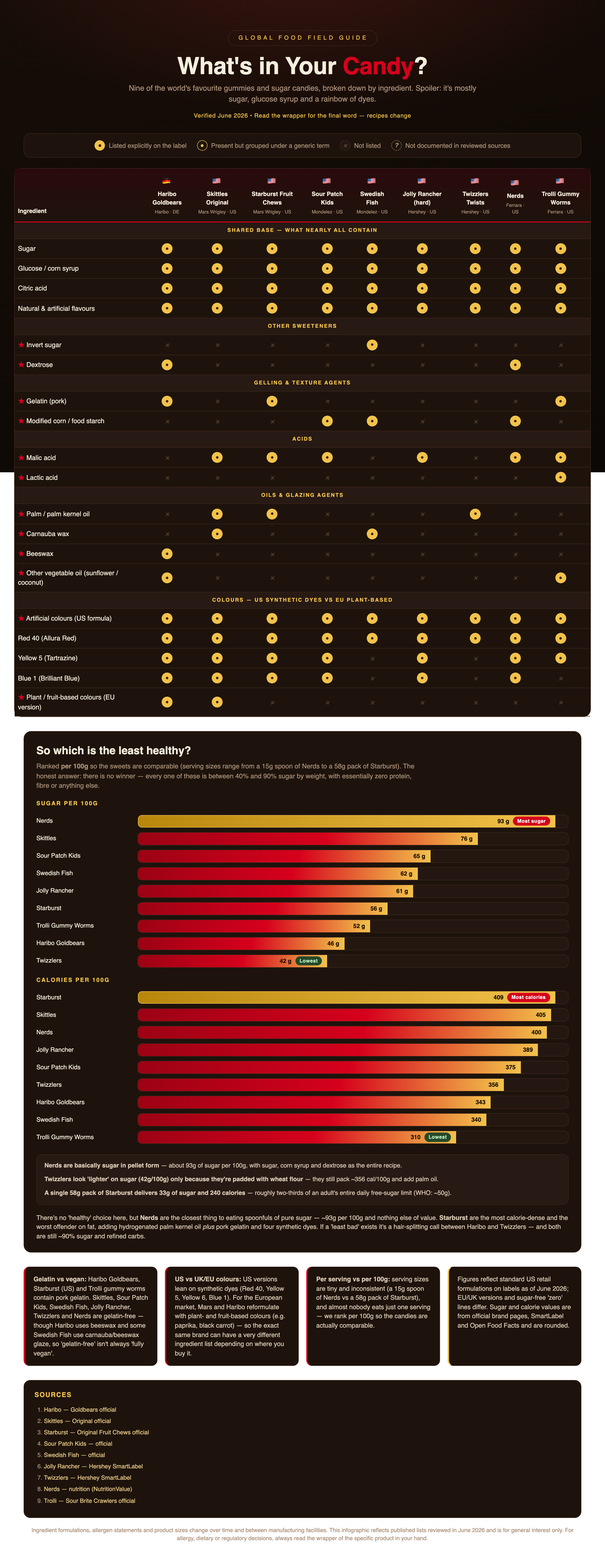
| Ingredient | 🇩🇪 Haribo Goldbears Haribo · DE | 🇺🇸 Skittles Original Mars Wrigley · US | 🇺🇸 Starburst Fruit Chews Mars Wrigley · US | 🇺🇸 Sour Patch Kids Mondelez · US | 🇺🇸 Swedish Fish Mondelez · US | 🇺🇸 Jolly Rancher (hard) Hershey · US | 🇺🇸 Twizzlers Twists Hershey · US | 🇺🇸 Nerds Ferrara · US | 🇺🇸 Trolli Gummy Worms Ferrara · US |
|---|---|---|---|---|---|---|---|---|---|
| Shared base — what nearly all contain | |||||||||
| Sugar | ● | ● | ● | ● | ● | ● | ● | ● | ● |
| Glucose / corn syrup | ● | ● | ● | ● | ● | ● | ● | ● | ● |
| Citric acid | ● | ● | ● | ● | ● | ● | ● | ● | ● |
| Natural & artificial flavours | ● | ● | ● | ● | ● | ● | ● | ● | ● |
| Other sweeteners | |||||||||
| Invert sugar | × | × | × | × | ● | × | × | × | × |
| Dextrose | ● | × | × | × | × | × | × | ● | × |
| Gelling & texture agents | |||||||||
| Gelatin (pork) | ● | × | ● | × | × | × | × | × | ● |
| Modified corn / food starch | × | × | × | ● | ● | × | × | ● | × |
| Acids | |||||||||
| Malic acid | × | ● | ● | ● | × | ● | × | ● | ● |
| Lactic acid | × | × | × | × | × | × | × | × | ● |
| Oils & glazing agents | |||||||||
| Palm / palm kernel oil | × | ● | ● | × | × | × | ● | × | × |
| Carnauba wax | × | ● | × | × | ● | × | × | × | × |
| Beeswax | ● | × | × | × | × | × | × | × | × |
| Other vegetable oil (sunflower / coconut) | ● | × | × | × | × | × | × | × | ● |
| Colours — US synthetic dyes vs EU plant-based | |||||||||
| Artificial colours (US formula) | ● | ● | ● | ● | ● | ● | ● | ● | ● |
| Red 40 (Allura Red) | ● | ● | ● | ● | ● | ● | ● | ● | ● |
| Yellow 5 (Tartrazine) | ● | ● | ● | ● | × | ● | × | ● | ● |
| Blue 1 (Brilliant Blue) | ● | ● | ● | ● | × | ● | × | ● | × |
| Plant / fruit-based colours (EU version) | ● | ● | × | × | × | × | × | × | × |
So which is the least healthy?
Ranked per 100g so the sweets are comparable (serving sizes range from a 15g spoon of Nerds to a 58g pack of Starburst). The honest answer: there is no winner — every one of these is between 40% and 90% sugar by weight, with essentially zero protein, fibre or anything else.
There's no 'healthy' choice here, but Nerds are the closest thing to eating spoonfuls of pure sugar — ~93g per 100g and nothing else of value. Starburst are the most calorie-dense and the worst offender on fat, adding hydrogenated palm kernel oil plus pork gelatin and four synthetic dyes. If a 'least bad' exists it's a hair-splitting call between Haribo and Twizzlers — and both are still ~90% sugar and refined carbs.
Gelatin vs vegan: Haribo Goldbears, Starburst (US) and Trolli gummy worms contain pork gelatin. Skittles, Sour Patch Kids, Swedish Fish, Jolly Rancher, Twizzlers and Nerds are gelatin-free — though Haribo uses beeswax and some Swedish Fish use carnauba/beeswax glaze, so 'gelatin-free' isn't always 'fully vegan'.
US vs UK/EU colours: US versions lean on synthetic dyes (Red 40, Yellow 5, Yellow 6, Blue 1). For the European market, Mars and Haribo reformulate with plant- and fruit-based colours (e.g. paprika, black carrot) — so the exact same brand can have a very different ingredient list depending on where you buy it.
Per serving vs per 100g: serving sizes are tiny and inconsistent (a 15g spoon of Nerds vs a 58g pack of Starburst), and almost nobody eats just one serving — we rank per 100g so the candies are actually comparable.
Figures reflect standard US retail formulations on labels as of June 2026; EU/UK versions and sugar-free 'zero' lines differ. Sugar and calorie values are from official brand pages, SmartLabel and Open Food Facts and are rounded.
Sources
Ingredient formulations, allergen statements and product sizes change over time and between manufacturing facilities. This infographic reflects published lists reviewed in June 2026 and is for general interest only. For allergy, dietary or regulatory decisions, always read the wrapper of the specific product in your hand.