What's in a Coca-Cola Around the World?
The same red can, but not the same recipe. Coca-Cola's short ingredient list barely changes from country to country — except for the one thing that defines its taste: the sweetener. We line up seven markets side by side.
Swipe the table sideways to see every column →
| Ingredient | 🇺🇸 USA | 🇲🇽 Mexico | 🇬🇧 UK & Ireland | 🇩🇪 Germany | 🇮🇳 India | 🇦🇺 Australia | 🇯🇵 Japan |
|---|---|---|---|---|---|---|---|
| Shared base | |||||||
| Carbonated water | ● | ● | ● | ● | ● | ● | ● |
| Sweeteners — the big difference | |||||||
| High-fructose corn syrup | ● | × | × | × | × | × | ● |
| Cane / beet sugar (sucrose) | × | ● | ● | ● | ● | ● | ● |
| Acids | |||||||
| Phosphoric acid | ● | ● | ● | ● | ● | ● | ● |
| Colour & flavour | |||||||
| Caramel colour (E150d) | ● | ● | ● | ● | ● | ● | ● |
| Natural flavours | ● | ● | ● | ● | ● | ● | ● |
| Stimulant | |||||||
| Caffeine | ● | ● | ● | ● | ● | ● | ● |
So which is the least healthy?
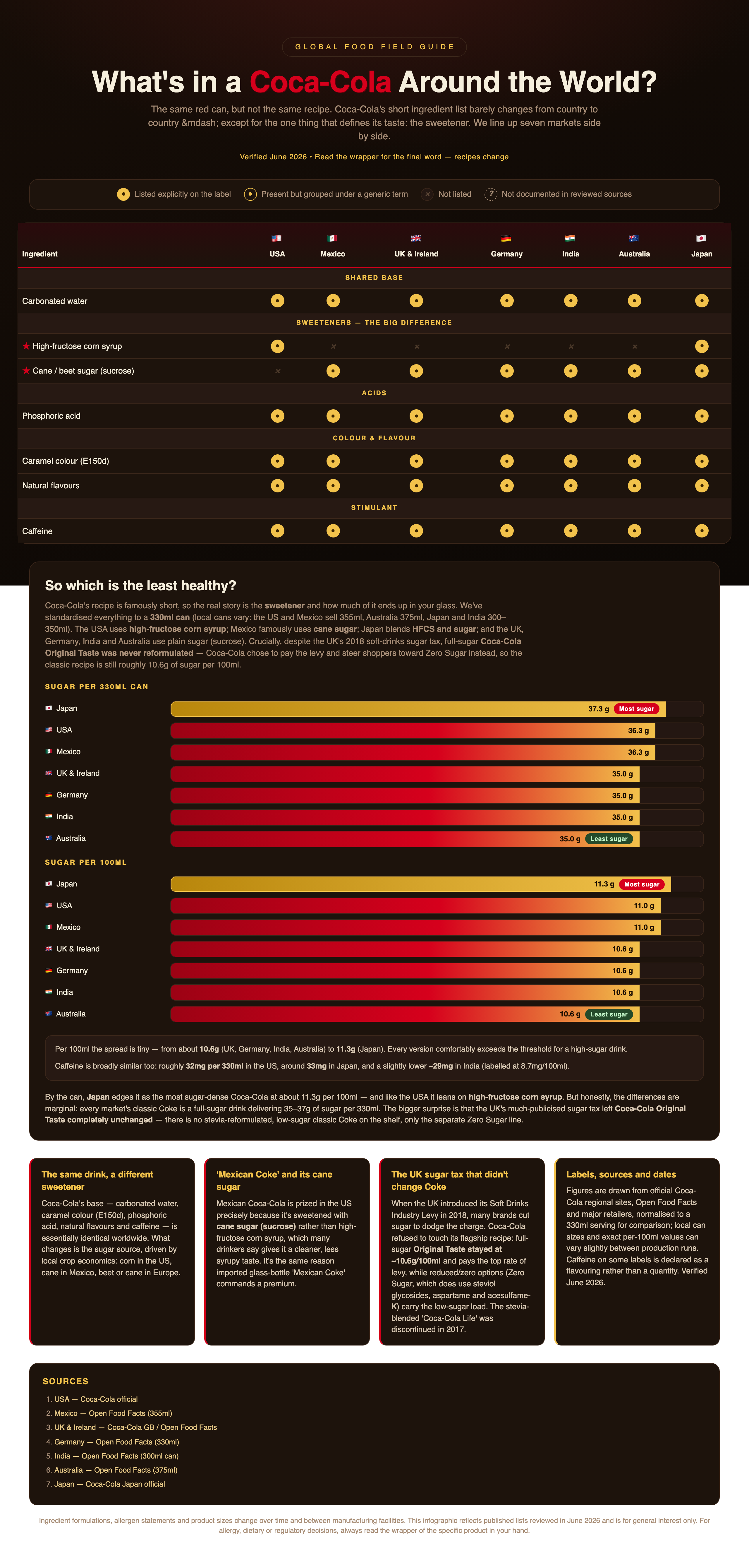
Coca-Cola's recipe is famously short, so the real story is the sweetener and how much of it ends up in your glass. We've standardised everything to a 330ml can (local cans vary: the US and Mexico sell 355ml, Australia 375ml, Japan and India 300–350ml). The USA uses high-fructose corn syrup; Mexico famously uses cane sugar; Japan blends HFCS and sugar; and the UK, Germany, India and Australia use plain sugar (sucrose). Crucially, despite the UK's 2018 soft-drinks sugar tax, full-sugar Coca-Cola Original Taste was never reformulated — Coca-Cola chose to pay the levy and steer shoppers toward Zero Sugar instead, so the classic recipe is still roughly 10.6g of sugar per 100ml.
By the can, Japan edges it as the most sugar-dense Coca-Cola at about 11.3g per 100ml — and like the USA it leans on high-fructose corn syrup. But honestly, the differences are marginal: every market's classic Coke is a full-sugar drink delivering 35–37g of sugar per 330ml. The bigger surprise is that the UK's much-publicised sugar tax left Coca-Cola Original Taste completely unchanged — there is no stevia-reformulated, low-sugar classic Coke on the shelf, only the separate Zero Sugar line.
The same drink, a different sweetener
Coca-Cola's base — carbonated water, caramel colour (E150d), phosphoric acid, natural flavours and caffeine — is essentially identical worldwide. What changes is the sugar source, driven by local crop economics: corn in the US, cane in Mexico, beet or cane in Europe.
'Mexican Coke' and its cane sugar
Mexican Coca-Cola is prized in the US precisely because it's sweetened with cane sugar (sucrose) rather than high-fructose corn syrup, which many drinkers say gives it a cleaner, less syrupy taste. It's the same reason imported glass-bottle 'Mexican Coke' commands a premium.
The UK sugar tax that didn't change Coke
When the UK introduced its Soft Drinks Industry Levy in 2018, many brands cut sugar to dodge the charge. Coca-Cola refused to touch its flagship recipe: full-sugar Original Taste stayed at ~10.6g/100ml and pays the top rate of levy, while reduced/zero options (Zero Sugar, which does use steviol glycosides, aspartame and acesulfame-K) carry the low-sugar load. The stevia-blended 'Coca-Cola Life' was discontinued in 2017.
Labels, sources and dates
Figures are drawn from official Coca-Cola regional sites, Open Food Facts and major retailers, normalised to a 330ml serving for comparison; local can sizes and exact per-100ml values can vary slightly between production runs. Caffeine on some labels is declared as a flavouring rather than a quantity. Verified June 2026.
Sources
Ingredient formulations, allergen statements and product sizes change over time and between manufacturing facilities. This infographic reflects published lists reviewed in June 2026 and is for general interest only. For allergy, dietary or regulatory decisions, always read the wrapper of the specific product in your hand.