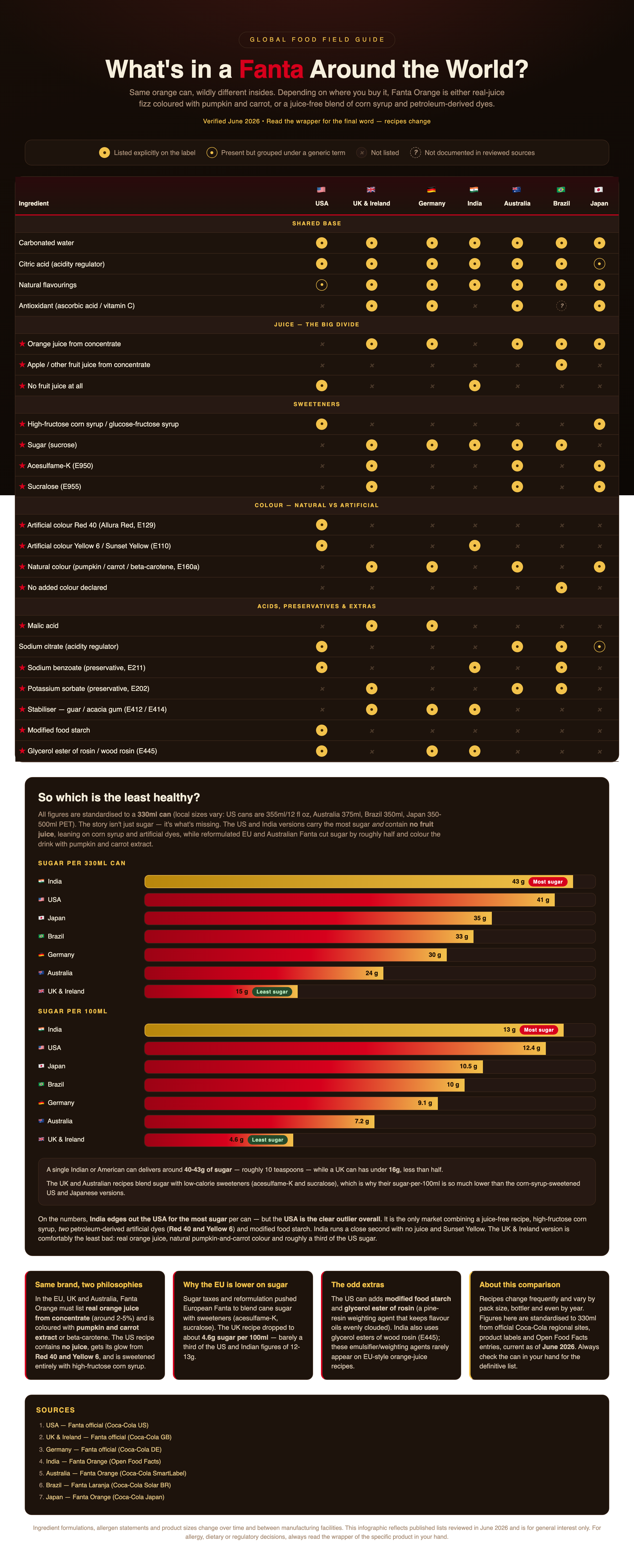
What's in a Fanta Around the World?
Same orange can, wildly different insides. Depending on where you buy it, Fanta Orange is either real-juice fizz coloured with pumpkin and carrot, or a juice-free blend of corn syrup and petroleum-derived dyes.
Swipe the table sideways to see every column →
| Ingredient | 🇺🇸 USA | 🇬🇧 UK & Ireland | 🇩🇪 Germany | 🇮🇳 India | 🇦🇺 Australia | 🇧🇷 Brazil | 🇯🇵 Japan |
|---|---|---|---|---|---|---|---|
| Shared base | |||||||
| Carbonated water | ● | ● | ● | ● | ● | ● | ● |
| Citric acid (acidity regulator) | ● | ● | ● | ● | ● | ● | ● |
| Natural flavourings | ● | ● | ● | ● | ● | ● | ● |
| Antioxidant (ascorbic acid / vitamin C) | × | ● | ● | × | ● | ? | ● |
| Juice — the big divide | |||||||
| Orange juice from concentrate | × | ● | ● | × | ● | ● | ● |
| Apple / other fruit juice from concentrate | × | × | × | × | × | ● | × |
| No fruit juice at all | ● | × | × | ● | × | × | × |
| Sweeteners | |||||||
| High-fructose corn syrup / glucose-fructose syrup | ● | × | × | × | × | × | ● |
| Sugar (sucrose) | × | ● | ● | ● | ● | ● | × |
| Acesulfame-K (E950) | × | ● | × | × | ● | × | ● |
| Sucralose (E955) | × | ● | × | × | ● | × | ● |
| Colour — natural vs artificial | |||||||
| Artificial colour Red 40 (Allura Red, E129) | ● | × | × | × | × | × | × |
| Artificial colour Yellow 6 / Sunset Yellow (E110) | ● | × | × | ● | × | × | × |
| Natural colour (pumpkin / carrot / beta-carotene, E160a) | × | ● | ● | × | ● | × | ● |
| No added colour declared | × | × | × | × | × | ● | × |
| Acids, preservatives & extras | |||||||
| Malic acid | × | ● | ● | × | × | × | × |
| Sodium citrate (acidity regulator) | ● | × | × | × | ● | ● | ● |
| Sodium benzoate (preservative, E211) | ● | × | × | ● | × | ● | × |
| Potassium sorbate (preservative, E202) | × | ● | × | × | ● | ● | × |
| Stabiliser — guar / acacia gum (E412 / E414) | × | ● | ● | ● | × | × | × |
| Modified food starch | ● | × | × | × | × | × | × |
| Glycerol ester of rosin / wood rosin (E445) | ● | × | ● | ● | × | × | × |
So which is the least healthy?
All figures are standardised to a 330ml can (local sizes vary: US cans are 355ml/12 fl oz, Australia 375ml, Brazil 350ml, Japan 350-500ml PET). The story isn't just sugar — it's what's missing. The US and India versions carry the most sugar and contain no fruit juice, leaning on corn syrup and artificial dyes, while reformulated EU and Australian Fanta cut sugar by roughly half and colour the drink with pumpkin and carrot extract.
On the numbers, India edges out the USA for the most sugar per can — but the USA is the clear outlier overall. It is the only market combining a juice-free recipe, high-fructose corn syrup, two petroleum-derived artificial dyes (Red 40 and Yellow 6) and modified food starch. India runs a close second with no juice and Sunset Yellow. The UK & Ireland version is comfortably the least bad: real orange juice, natural pumpkin-and-carrot colour and roughly a third of the US sugar.
Same brand, two philosophies
In the EU, UK and Australia, Fanta Orange must list real orange juice from concentrate (around 2-5%) and is coloured with pumpkin and carrot extract or beta-carotene. The US recipe contains no juice, gets its glow from Red 40 and Yellow 6, and is sweetened entirely with high-fructose corn syrup.
Why the EU is lower on sugar
Sugar taxes and reformulation pushed European Fanta to blend cane sugar with sweeteners (acesulfame-K, sucralose). The UK recipe dropped to about 4.6g sugar per 100ml — barely a third of the US and Indian figures of 12-13g.
The odd extras
The US can adds modified food starch and glycerol ester of rosin (a pine-resin weighting agent that keeps flavour oils evenly clouded). India also uses glycerol esters of wood rosin (E445); these emulsifier/weighting agents rarely appear on EU-style orange-juice recipes.
About this comparison
Recipes change frequently and vary by pack size, bottler and even by year. Figures here are standardised to 330ml from official Coca-Cola regional sites, product labels and Open Food Facts entries, current as of June 2026. Always check the can in your hand for the definitive list.
Sources
Ingredient formulations, allergen statements and product sizes change over time and between manufacturing facilities. This infographic reflects published lists reviewed in June 2026 and is for general interest only. For allergy, dietary or regulatory decisions, always read the wrapper of the specific product in your hand.