The Salt in Your Instant Noodles
Nine instant noodles from around the world, lined up by what's in the packet. The story is salt: one pack can deliver most of a day's limit before you've added anything.
Swipe the table sideways to see every column →
| Ingredient | 🇮🇳 Maggi Masala Nestlé · IN | 🇮🇩 Indomie Mi Goreng Indofood · ID | 🇺🇸 Cup Noodles Nissin · US | 🇰🇷 Shin Ramyun Nongshim · KR | 🇺🇸 Top Ramen Nissin · US | 🇺🇸 Maruchan Ramen Maruchan · US | 🇰🇷 Buldak Hot Chicken Samyang · KR | 🇹🇭 Mama Beef Mama · TH | 🇭🇰 Demae Ramen Nissin · HK |
|---|---|---|---|---|---|---|---|---|---|
| Shared base — what nearly all contain | |||||||||
| Wheat flour noodles | ● | ● | ● | ● | ● | ● | ● | ● | ● |
| Palm oil (noodles are fried in it) | ● | ● | ● | ● | ● | ● | ● | ● | ● |
| Added salt | ● | ● | ● | ● | ● | ● | ● | ● | ● |
| Noodle dough & texture | |||||||||
| Modified / tapioca starch (springier bite) | × | ● | × | ● | × | × | ● | ● | × |
| Kansui — alkaline mineral salts (E500/E501) | × | × | ● | ● | ● | ● | ● | ● | ● |
| Thickener / guar gum (E412) | ● | ● | × | × | × | × | × | × | × |
| Seasoning | |||||||||
| Sugar | ● | ● | ● | ● | ● | ● | ● | ● | ● |
| Chilli / spice blend | ● | ● | × | ● | × | × | ● | ● | ● |
| Onion & garlic | ● | ● | ● | ● | ● | ● | ● | ● | ● |
| Soy sauce | × | ● | × | × | × | × | ● | ● | ● |
| Flavour enhancers | |||||||||
| MSG — monosodium glutamate (E621) | × | ● | × | ● | ● | ● | ● | ● | ● |
| Disodium inosinate & guanylate (E627/E631) | ● | ● | × | ● | ● | ● | ● | ● | ● |
| Colour, veg & extras | |||||||||
| Dehydrated vegetables (carrot, corn, mushroom, onion) | × | × | ● | ● | × | × | × | × | ● |
| Added colour (riboflavin / turmeric / caramel) | ● | ● | × | × | ● | ● | × | × | × |
| Separate seasoning-oil / sesame-oil sachet | × | ● | × | × | × | × | ● | × | ● |
| Contains egg | × | × | ● | × | × | × | × | × | ● |
So which is the least healthy?
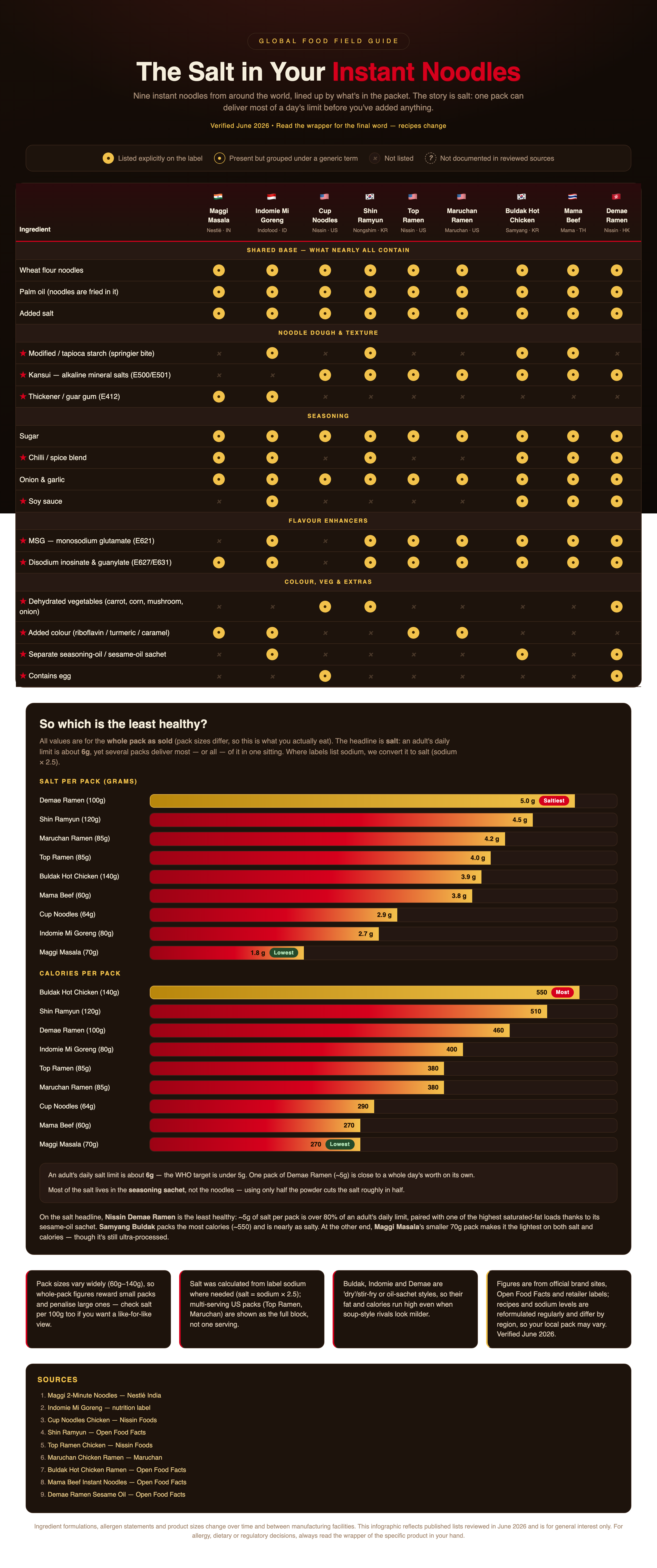
All values are for the whole pack as sold (pack sizes differ, so this is what you actually eat). The headline is salt: an adult's daily limit is about 6g, yet several packs deliver most — or all — of it in one sitting. Where labels list sodium, we convert it to salt (sodium × 2.5).
On the salt headline, Nissin Demae Ramen is the least healthy: ~5g of salt per pack is over 80% of an adult's daily limit, paired with one of the highest saturated-fat loads thanks to its sesame-oil sachet. Samyang Buldak packs the most calories (~550) and is nearly as salty. At the other end, Maggi Masala's smaller 70g pack makes it the lightest on both salt and calories — though it's still ultra-processed.
Pack sizes vary widely (60g–140g), so whole-pack figures reward small packs and penalise large ones — check salt per 100g too if you want a like-for-like view.
Salt was calculated from label sodium where needed (salt = sodium × 2.5); multi-serving US packs (Top Ramen, Maruchan) are shown as the full block, not one serving.
Buldak, Indomie and Demae are 'dry'/stir-fry or oil-sachet styles, so their fat and calories run high even when soup-style rivals look milder.
Figures are from official brand sites, Open Food Facts and retailer labels; recipes and sodium levels are reformulated regularly and differ by region, so your local pack may vary. Verified June 2026.
Sources
- Maggi 2-Minute Noodles — Nestlé India
- Indomie Mi Goreng — nutrition label
- Cup Noodles Chicken — Nissin Foods
- Shin Ramyun — Open Food Facts
- Top Ramen Chicken — Nissin Foods
- Maruchan Chicken Ramen — Maruchan
- Buldak Hot Chicken Ramen — Open Food Facts
- Mama Beef Instant Noodles — Open Food Facts
- Demae Ramen Sesame Oil — Open Food Facts
Ingredient formulations, allergen statements and product sizes change over time and between manufacturing facilities. This infographic reflects published lists reviewed in June 2026 and is for general interest only. For allergy, dietary or regulatory decisions, always read the wrapper of the specific product in your hand.