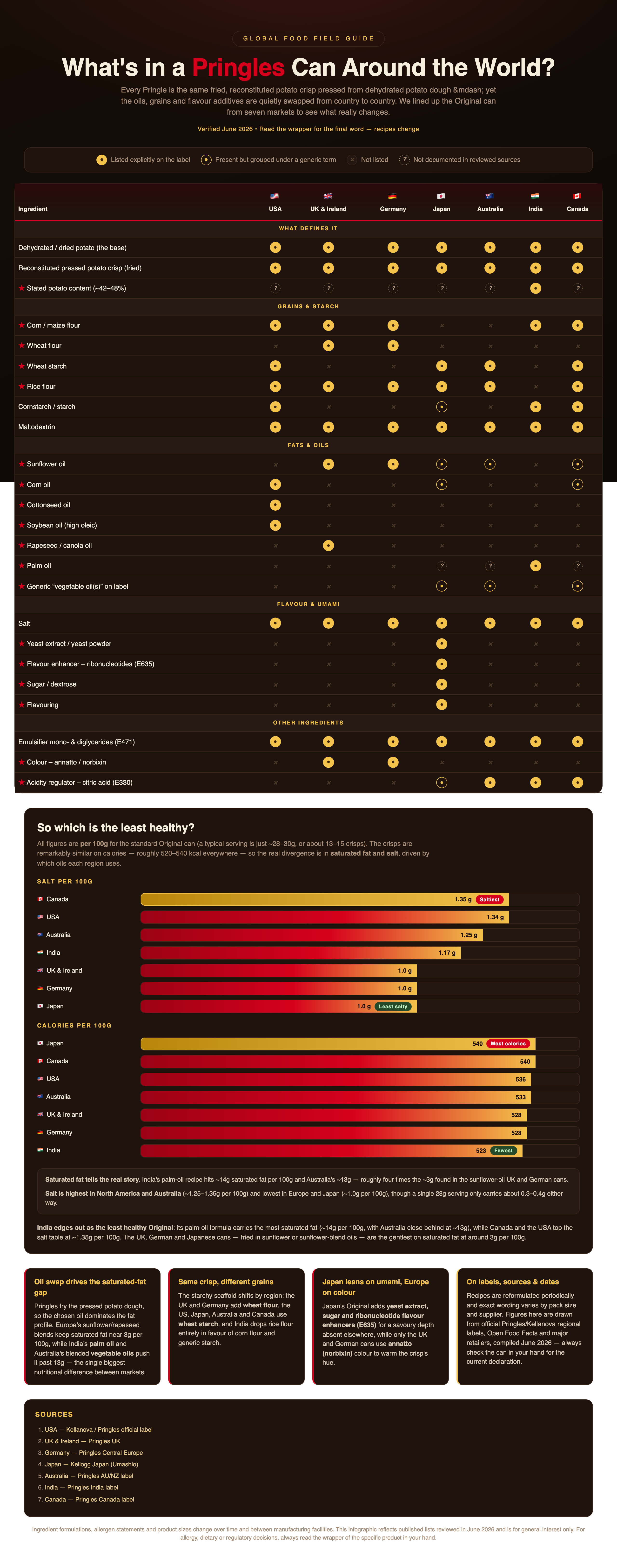
What's in a Pringles Can Around the World?
Every Pringle is the same fried, reconstituted potato crisp pressed from dehydrated potato dough — yet the oils, grains and flavour additives are quietly swapped from country to country. We lined up the Original can from seven markets to see what really changes.
Swipe the table sideways to see every column →
| Ingredient | 🇺🇸 USA | 🇬🇧 UK & Ireland | 🇩🇪 Germany | 🇯🇵 Japan | 🇦🇺 Australia | 🇮🇳 India | 🇨🇦 Canada |
|---|---|---|---|---|---|---|---|
| What defines it | |||||||
| Dehydrated / dried potato (the base) | ● | ● | ● | ● | ● | ● | ● |
| Reconstituted pressed potato crisp (fried) | ● | ● | ● | ● | ● | ● | ● |
| Stated potato content (~42–48%) | ? | ? | ? | ? | ? | ● | ? |
| Grains & starch | |||||||
| Corn / maize flour | ● | ● | ● | × | × | ● | ● |
| Wheat flour | × | ● | ● | × | × | × | × |
| Wheat starch | ● | × | × | ● | ● | × | ● |
| Rice flour | ● | ● | ● | ● | ● | × | ● |
| Cornstarch / starch | ● | × | × | ● | × | ● | ● |
| Maltodextrin | ● | ● | ● | ● | ● | ● | ● |
| Fats & oils | |||||||
| Sunflower oil | × | ● | ● | ● | ● | × | ● |
| Corn oil | ● | × | × | ● | × | × | ● |
| Cottonseed oil | ● | × | × | × | × | × | × |
| Soybean oil (high oleic) | ● | × | × | × | × | × | × |
| Rapeseed / canola oil | × | ● | × | × | × | × | × |
| Palm oil | × | × | × | ? | ? | ● | ? |
| Generic “vegetable oil(s)” on label | × | × | × | ● | ● | × | ● |
| Flavour & umami | |||||||
| Salt | ● | ● | ● | ● | ● | ● | ● |
| Yeast extract / yeast powder | × | × | × | ● | × | × | × |
| Flavour enhancer – ribonucleotides (E635) | × | × | × | ● | × | × | × |
| Sugar / dextrose | × | × | × | ● | × | × | × |
| Flavouring | × | × | × | ● | × | × | × |
| Other ingredients | |||||||
| Emulsifier mono- & diglycerides (E471) | ● | ● | ● | ● | ● | ● | ● |
| Colour – annatto / norbixin | × | ● | ● | × | × | × | × |
| Acidity regulator – citric acid (E330) | × | × | × | ● | ● | ● | ● |
So which is the least healthy?
All figures are per 100g for the standard Original can (a typical serving is just ~28–30g, or about 13–15 crisps). The crisps are remarkably similar on calories — roughly 520–540 kcal everywhere — so the real divergence is in saturated fat and salt, driven by which oils each region uses.
India edges out as the least healthy Original: its palm-oil formula carries the most saturated fat (~14g per 100g, with Australia close behind at ~13g), while Canada and the USA top the salt table at ~1.35g per 100g. The UK, German and Japanese cans — fried in sunflower or sunflower-blend oils — are the gentlest on saturated fat at around 3g per 100g.
Oil swap drives the saturated-fat gap
Pringles fry the pressed potato dough, so the chosen oil dominates the fat profile. Europe's sunflower/rapeseed blends keep saturated fat near 3g per 100g, while India's palm oil and Australia's blended vegetable oils push it past 13g — the single biggest nutritional difference between markets.
Same crisp, different grains
The starchy scaffold shifts by region: the UK and Germany add wheat flour, the US, Japan, Australia and Canada use wheat starch, and India drops rice flour entirely in favour of corn flour and generic starch.
Japan leans on umami, Europe on colour
Japan's Original adds yeast extract, sugar and ribonucleotide flavour enhancers (E635) for a savoury depth absent elsewhere, while only the UK and German cans use annatto (norbixin) colour to warm the crisp's hue.
On labels, sources & dates
Recipes are reformulated periodically and exact wording varies by pack size and supplier. Figures here are drawn from official Pringles/Kellanova regional labels, Open Food Facts and major retailers, compiled June 2026 — always check the can in your hand for the current declaration.
Sources
Ingredient formulations, allergen statements and product sizes change over time and between manufacturing facilities. This infographic reflects published lists reviewed in June 2026 and is for general interest only. For allergy, dietary or regulatory decisions, always read the wrapper of the specific product in your hand.